 Senior Product Designer
Test the alert workflow while it can change.
I led design for CommandCentral Notify from early concepts through release. I put proposals in front of public-safety customers while the team could still change how operators would prepare and send an alert.
An alert has to reach the right people.
CommandCentral Notify supports public-safety teams sending urgent information to a community. The product needed to connect three separate decisions: who should receive an alert, which channels should carry it and what they need to know. A usable workflow has to make those choices understandable when people have little time to work through them.
I led the design process and set its direction, working with design, engineering and business partners. My job was to turn the requirements into a workflow the team could put in front of the people who would use it. We used story mapping to work through the requirements and combined desk research, personas and competitive analysis to prepare the first concepts.
Show the concept before it hardens.
We took early concepts to public-safety customers before committing to the interface. It gave us a way to ask about the workflow while there were still alternatives: where operators expected to define a scenario, what they needed to see while preparing the alert, and which parts should already be set up before an event.
We followed customer demonstrations with remote usability testing and card sorting, then brought the work back to customers. The methods served different purposes. A walkthrough lets a customer explain how they would do the work. A usability session lets you see whether somebody can find and use the controls. Card sorting helps you understand where people expect related controls to live.
- Concept
- Can an operator recognise the workflow and explain how it would fit their work?
- Controls
- Can they find the parts they need, and do the groups make sense?
- Revision
- Does the revised interface still hold up when customers see it again?
The leadership decision was when to invite people in. Early concepts gave the team room to reconsider the structure. Once development was implementing the flow, changes had a different cost. Returning to customers before release gave us a chance to see the work again with the people who understood the setting.
Prepare the scenario before the incident.
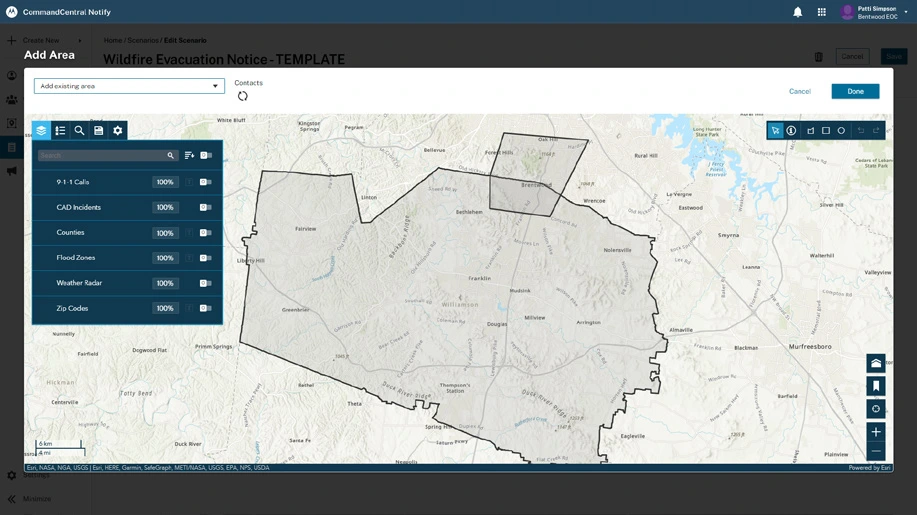
A feature in the released product makes the design problem easier to see. Operators can prepare and save a scenario for later use. For example, an evacuation template can start with an area already defined. At the moment of use, the operator can see who the alert is intended to reach and review the prepared information before acting.
Choose recipients
- Recipients
- Evacuation area
- Channels
- Still to choose
- Message
- Still to review
Start with the area the notification needs to cover. A saved scenario can already carry that area.
Check channels
- Recipients
- Evacuation area
- Channels
- Text, voice and email
- Message
- Still to review
Check how the people in that area will receive the alert.
Review the scenario
- Recipients
- Evacuation area
- Channels
- Text, voice and email
- Message
- Evacuation instructions
Review recipients, channels and message together. This example shows preparation before sending.
The public workflow also shows why the recipient decision and the channel decision belong apart. An area or a group describes whom an operator intends to reach. Text, voice and email describe how the alert goes out. A person reviewing a scenario needs to be able to check each part on its own.
The template is a good example of separating preparation from action. Working out common scenarios ahead of time gives the team something concrete to review and update. In an incident the operator can start from that work and check it against what is happening.
Learn the context the tool operates in.
I completed FEMA Independent Study course IS-00251.a, Integrated Public Alert and Warning System (IPAWS) for Alerting Administrators, in April 2021. It gave me a way to study the alerting context alongside the product work.
The released product provides an example of the kind of workflow we worked on. Our project record establishes the design sequence and the methods we used. It does not give a measured change in alerting speed or identify one test result as the reason for any particular released control.
I led the design through implementation and market release. The public product material shows the workflow the team delivered. The lesson I took from it was to use different forms of evidence at different moments: establish how operators work, let them try the controls before implementation, and come back with the revision while there is still time to act on what they find.