 UX Team Lead
Put invoice answers where approval happens.
I led design for accounts payable automation at Medius. I aligned priorities with product managers and business analysts and ran the design sprint that produced our first Copilot concept.
Four development teams needed a shared direction.
My remit covered the accounts payable product, where the invoice connects several jobs. Someone has to understand what is being billed, check the coding, and decide whether the invoice can move forward. For an approver, the question is often narrow: what am I responsible for here, and what would stop me signing off?
I worked with product managers and business analysts to align roadmap priorities and ran the design sprint that produced the first Copilot concept. The sprint made it possible to talk about a specific point in the workflow. We had an invoice in front of us, an approver with an open decision, and a way to try out which context belonged beside it. That gave four development teams a shared direction for delivery.
Keep the invoice in view.
I framed the concept around the approval decision. The approver needs to see the invoice itself and be able to check details about it. A question about the supplier or a line of coding matters because it can clarify whether to approve or return the invoice. Putting that context beside the invoice lets the approver keep the thing they are deciding about in sight.
The first concept gave us a useful boundary for the roadmap. We could evaluate a specific question, such as whether the approver could tell if it was their turn, before considering more ambitious ways of using AI elsewhere in accounts payable.
The trade-off is what belongs in that view. A supplier’s entire history could distract from the job. Recent invoices can help the approver investigate a specific question. The design needed to let them get more detail while keeping the amount, approval responsibility and possible next actions easy to find.
Two things an approver needs to check.
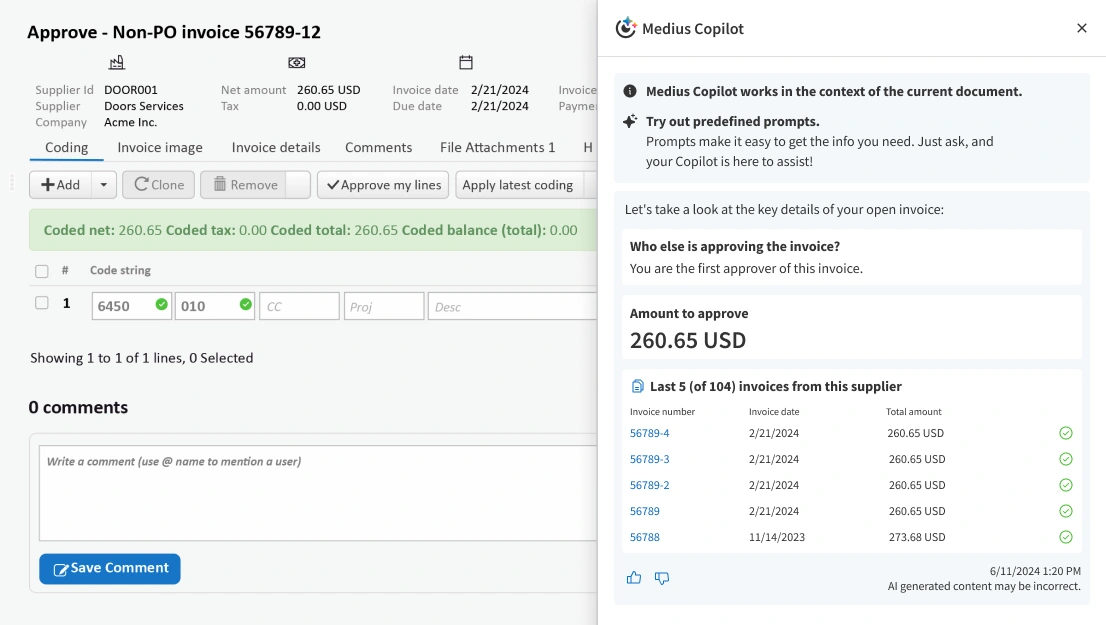
In the public Medius demo, the invoice is already open. Copilot can answer specific questions in context, including about the amount to approve, the user’s place in the approval chain and the supplier’s recent invoices. The next step depends on what the approver finds.
Check context
- To approve
- 260.65 USD
- Invoice and coding
- Not yet checked
- Next action
- Review the invoice
In the Medius demo, Copilot shows the approver that they’re first in the chain and can check five recent invoices from the supplier. The approver still has to review the invoice and its coding.
Coding is correct
- To approve
- 260.65 USD
- Invoice and coding
- Checked
- Next action
- Approve your lines
Once the coding checks out, the approver can approve the lines they’re responsible for.
Coding needs correction
- To approve
- 260.65 USD
- Invoice and coding
- Needs a correction
- Next action
- Return the invoice
The approver can ask Copilot how to return the invoice for correction. The approver decides whether to send it back.
Consider the supplier-history example. Seeing five recent invoices can help an approver decide whether to investigate an amount, but a similar amount is evidence to look closer, never proof that the current invoice is correct. The important handoff in the interface is the return to the invoice and its coding before the approver acts.
The two checks ask for different things from the interface. The first is about getting an answer with enough context to verify it against the invoice. The second is about finding the action that matches the decision already made by the approver. Keeping that distinction clear makes the feature easier to evaluate than a general question about whether the assistant feels helpful.
Two agents with different jobs.
Medius announced Copilot and Supplier Conversations on 27 June 2024. Copilot supports the internal approver. Supplier Conversations handles enquiries from suppliers by email, including looking up payment status. That distinction matters because both tools deal with invoices, but the people, decisions and ways to finish the task are different.
The launch and demo answer different questions. The launch documents what Medius released. The demo shows the interaction an approver can actually inspect. From those sources we can see the path from asking for context to choosing an action. Whether people approve more accurately or spend less time per invoice would need a separate measurement.
My role was to align the roadmap and lead the sprint that produced the first approval concept. The public release shows how the product team took that direction into the workflow. The demo gives a concrete way to inspect the result: open the invoice, ask for the information needed and make the approval decision.